

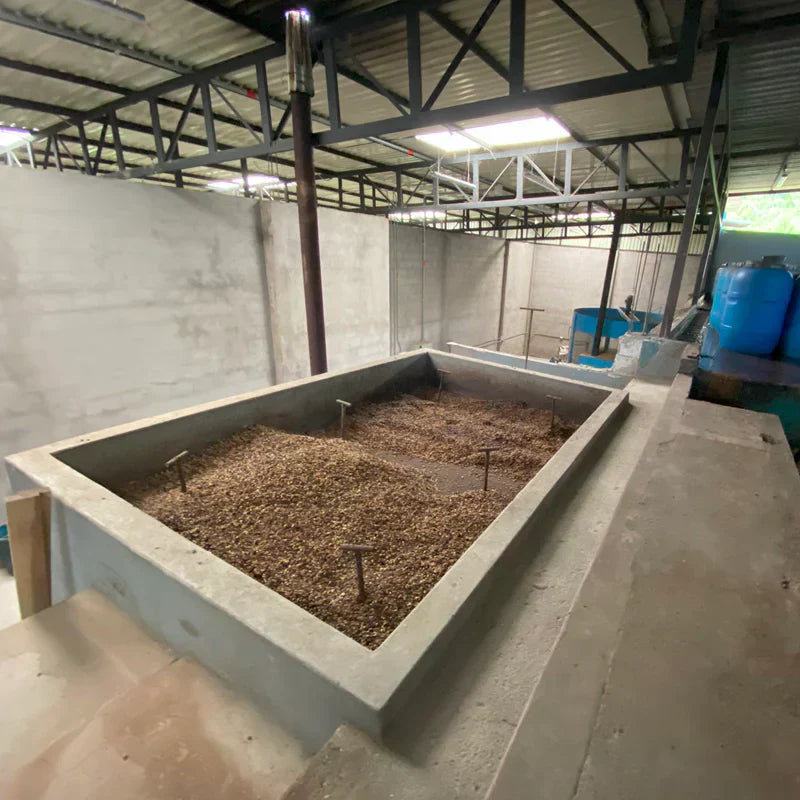
The process of decaffeination has evolved significantly over the years as people have paid attention to consumer markets demanding more flavor in their decaf cups. What was once associated with dull, lifeless cups can now yield coffees that are expressive, nuanced, and deeply satisfying. Much of this improvement comes down to how caffeine is removed from green coffee beans and the research and science that has been applied to these processes. Below, we break down three key decaffeination processes and highlight why one in particular plays an important role in our latest Colombian release: the Black Condor decaf.
Swiss Water Process

The Swiss Water Process is one of the most well-known decaffeination methods, prized for being chemical-free and gentle on the beans. In this method, green coffee is soaked in hot water to dissolve caffeine along with other soluble compounds. This water is then passed through an activated carbon filter that traps caffeine molecules while allowing most flavor compounds to remain in the solution.
The flavor-rich solution is then reused to decaffeinate subsequent batches of coffee. Because the water is already saturated with flavor compounds, it pulls out very little beyond caffeine, helping to preserve the inherent character of the coffee without introducing synthetic solvents. This approach produces clean, balanced decaf coffees, though the extended exposure to water can sometimes soften the most delicate aromatics.
Mountain Water Process
The Mountain Water Process operates on a similar principle to Swiss Water, using water and filtration rather than chemical solvents. The distinction lies primarily in location and branding. Mexican Mountain Water decaffeination is conducted using water sourced from Pico de Orizaba and carbon filtration, achieving decaffeination through diffusion just like Swiss Water. Although the processes are closely related, they are distinct operations associated with different facilities and regional water sources.
Both methods aim to remove caffeine while maintaining flavor clarity, resulting in coffees that are smooth and approachable. However, like any water-intensive process, some subtle flavor notes can be muted compared to the original bean.
Sugarcane / Ethyl Acetate Process

The sugarcane or ethyl acetate (EA) process takes a different approach that can preserve more of a coffee’s nuanced flavor profile. In this method, green coffee beans are first steamed to open their structure. They are then rinsed with a solution containing ethyl acetate, a naturally occurring compound that can be derived from fermented sugarcane. Ethyl acetate selectively bonds with caffeine molecules and draws them out of the bean without stripping away many of the desirable flavor compounds. After the caffeine is removed, the beans are steamed again to eliminate any residual solvent.
This process tends to retain more sweetness, acidity, and subtle aromatics, producing decaf coffees that feel vibrant and expressive — characteristics that can be diminished in some water-based decaffeination methods. By preserving more of the coffee’s inherent flavor, sugarcane decaf often tastes closer to a fully caffeinated coffee in complexity and depth.
Colombia Black Condor Decaf
Our Colombia Black Condor Decaf is a vivid example of how thoughtful decaffeination can elevate the quality of a decaf cup. Sourced from El Vergel Estate in Tolima and grown at 1450 meters above sea level, this coffee begins as a fully washed Red and Yellow Caturra lot before being transported to Descafecol for sugarcane EA decaffeination.
During processing, the green beans are gently steamed and soaked in water and ethyl acetate derived from sugarcane. This low-temperature, selective extraction helps preserve the coffee’s natural character and origin expression. A final steam bath removes any remaining residues, ensuring a clean, expressive cup that still feels true to where it came from.

In the cup, this decaf delivers balanced sweetness with notes of almond and light brown sugar, followed by soft citrus brightness and a subtle clove spice on the finish. It’s smooth and structured — ideal for both espresso and filter brew methods — and showcases how a carefully chosen decaffeination process can retain complexity even after caffeine has been removed.


1 comment
Gran ejemplo de responsabilidad social. Visita nuestro sitio web Telkom University Jakarta